Booking choice: The ceremony in a real Mevlevi lodge, from $26 per person. Check dates Tour details
People come out of a Sema with the same two questions: why do they spin, and how do they not fall over? Both have good answers. The first comes from the Mevlevi tradition itself, the second from UNESCO's description of the technique, the old training in the lodges and, more recently, two brain studies.
Sources are named in plain text: UNESCO, GoTürkiye (the Turkish Ministry of Culture and Tourism's tourism site), HodjaPasha, Wikipedia and the scientific journals named below. Venue details come from each listing.
The quick answer
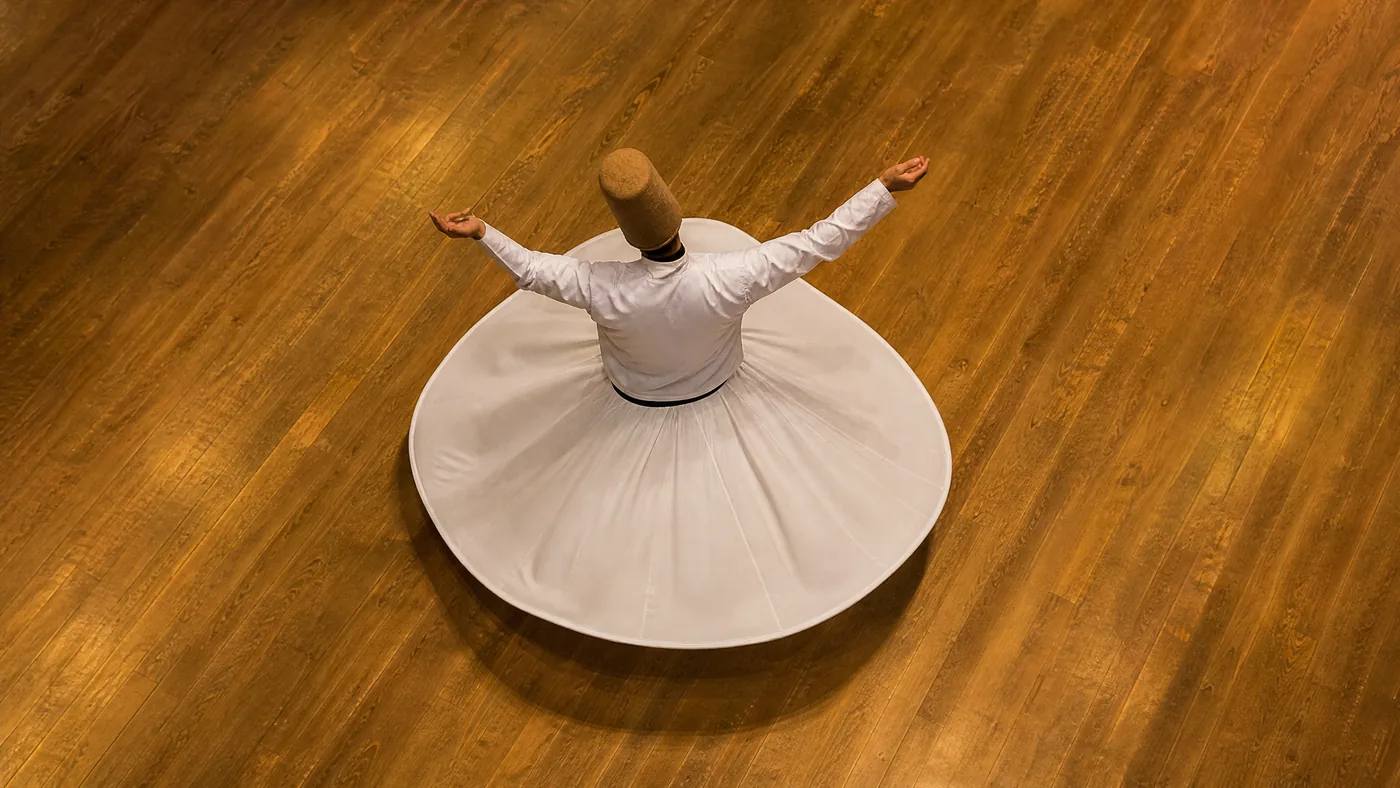
Dervishes spin as a form of prayer and remembrance of God. GoTürkiye puts it simply: everything in the universe turns, so the Mevlevi dervishes whirl with the love of God. The right palm faces up to receive, the left faces down to pass it on to the earth. They avoid dizziness through technique and long training: UNESCO describes short twists on the left foot with the eyes open but unfocused.
Why do whirling dervishes spin?
To pray. The turning is a way of remembering God and letting go of the self, and in Mevlevi thought it joins the turning of everything else in creation.
GoTürkiye's page on Konya gives the Mevlevi view in a few lines: the Earth and the planets revolve, electrons circle in atoms, blood circulates in the body, living things return from the earth to the earth. "For this reason, Mevlevi Dervishes whirl with the love of God."
Wikipedia's article on the Mevlevi order adds the inner side. With each full turn the semazen inwardly says "Allah", a form of dhikr, the remembrance of God. Its article on Sufi whirling describes the aim as reaching a closer connection with God by abandoning the ego, listening to the music and focusing on God. The word semazen itself comes from sema, "listening".
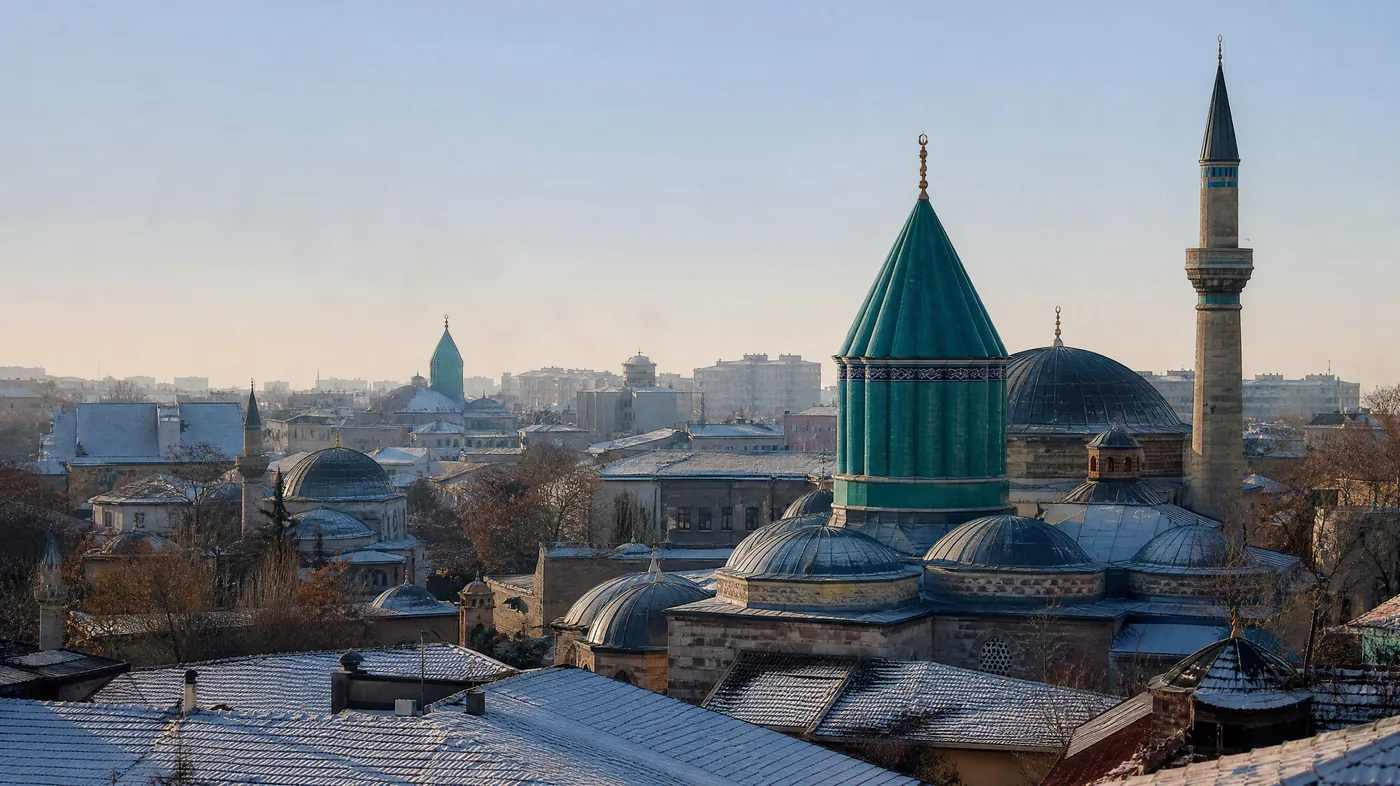
A popular story says Rumi first whirled when he heard the goldsmiths hammering in Konya's bazaar. It is a story, and a good one. More on Rumi and the order in our guide to Sufis, dervishes and Rumi.
What is a whirling dervish ceremony?
The Sema: a Mevlevi religious ceremony of music, prayer and whirling. UNESCO inscribed it on its Representative List of the Intangible Cultural Heritage of Humanity in 2008, after first proclaiming it in 2005.
HodjaPasha answers the question in its own FAQ: "It is a spiritual ceremony that contains religious symbols." UNESCO describes the music, the ayin, in four sections of vocal and instrumental pieces, played by at least one singer, a ney (reed flute) player, a kettledrummer and a cymbal player. The Mevlevi order itself was founded in 1273 in Konya, and its most active centers today are Konya and Istanbul, per UNESCO.
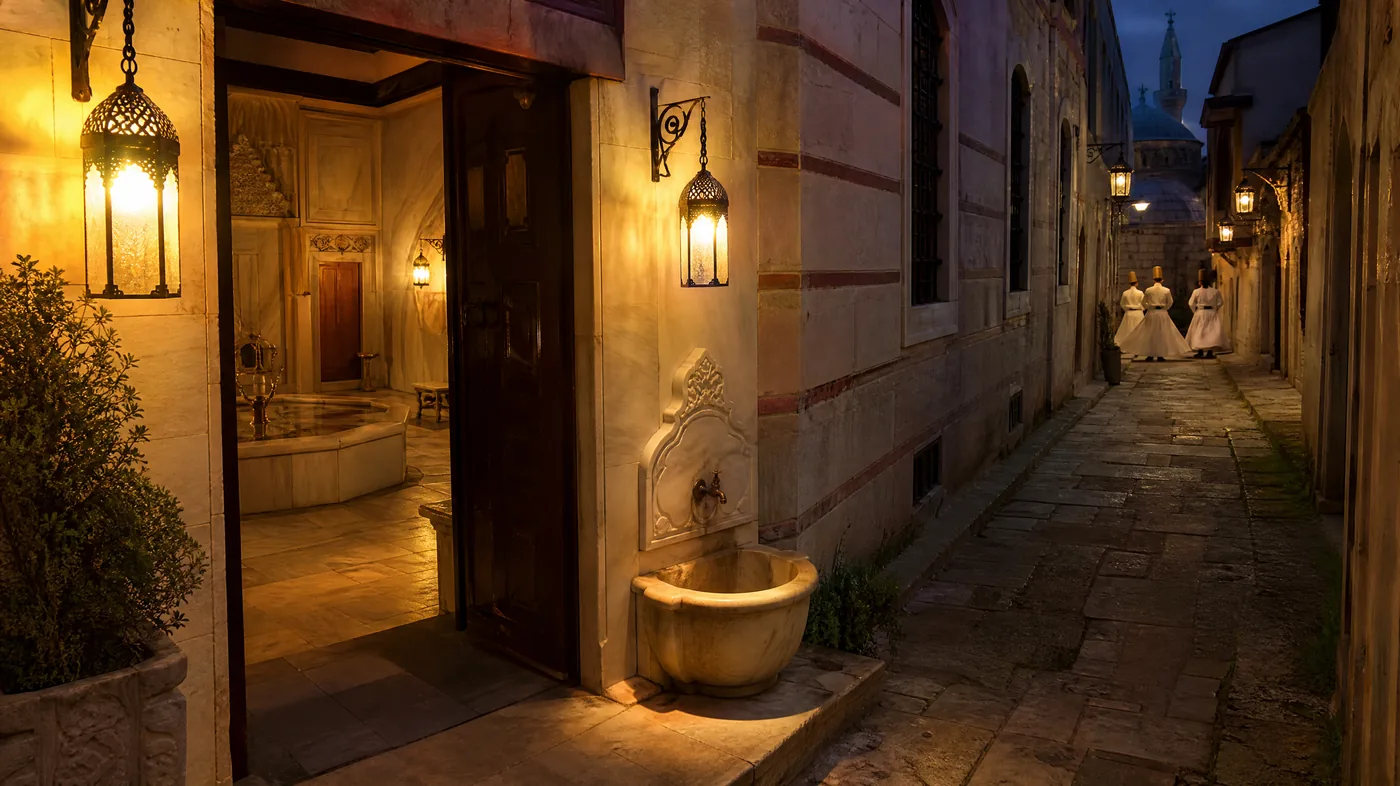
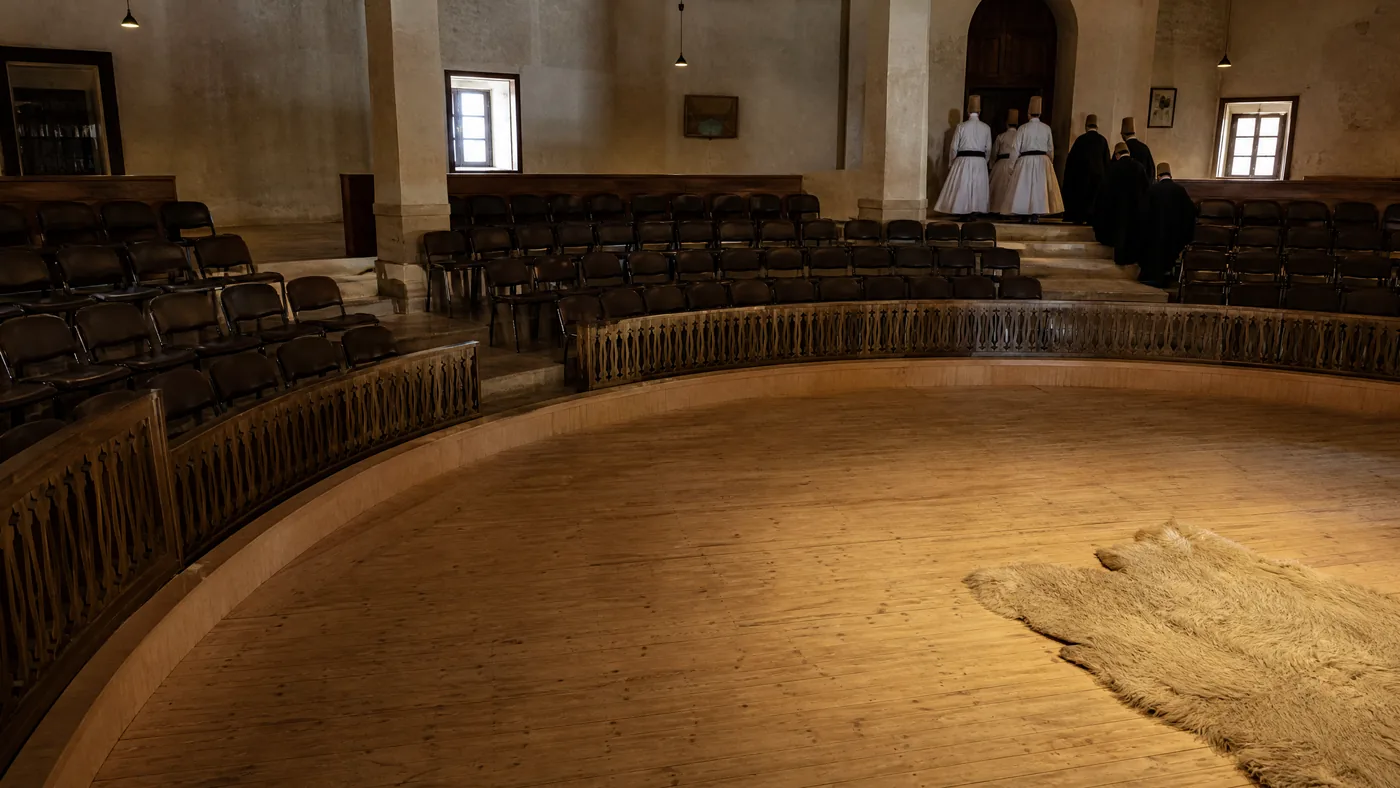
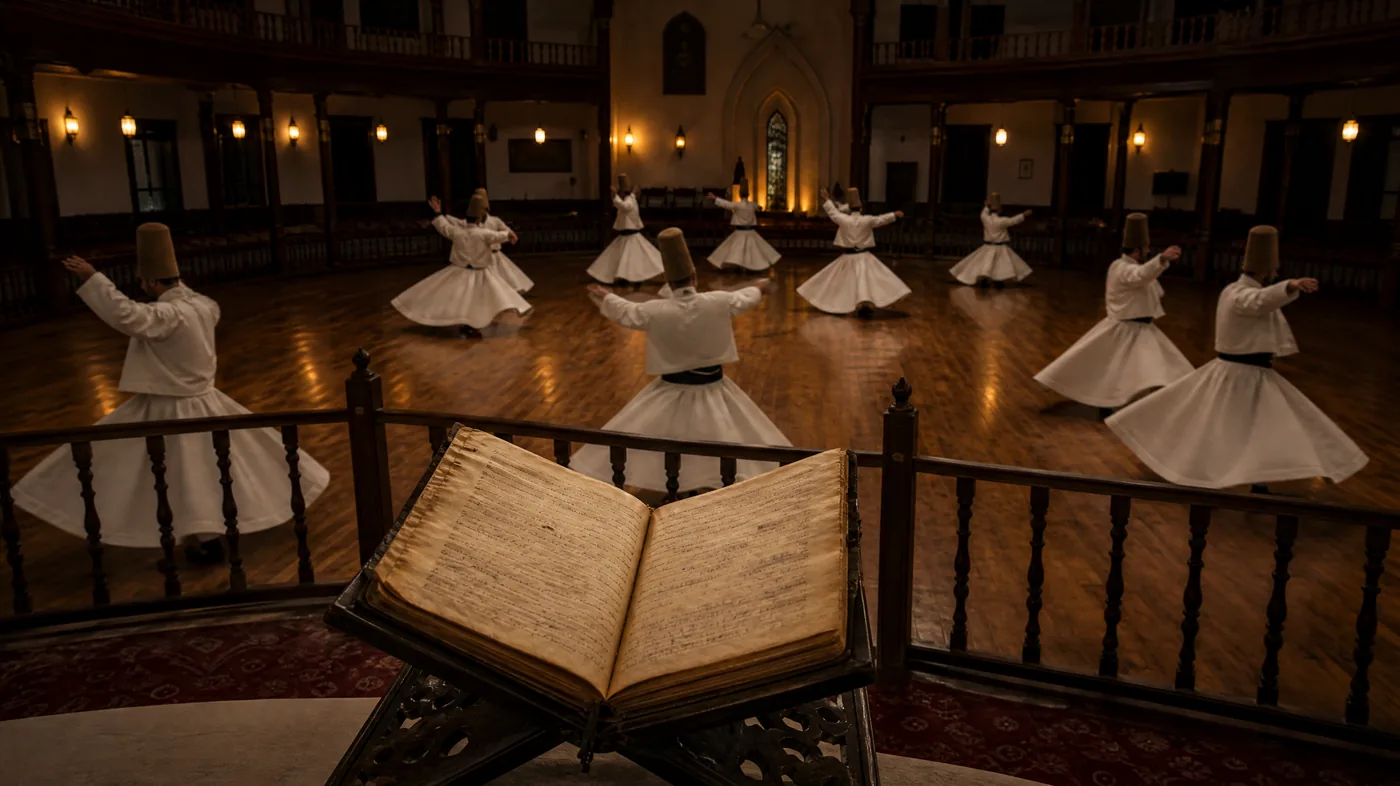
Traditionally the Sema takes place in a semahane, a ritual hall, with the dervishes turning in a circle around their sheikh. In Istanbul you can still see it in a lodge built for it: the Kasimpasa Mevlevihanesi, founded in the 1620s.
What do the hat, skirt, cloak and hands mean?
The hat is the tombstone of the ego, the white skirt its shroud, the black cloak the grave. The right palm turns up to receive from God, the left down to pass it to the earth.
The symbols, as Wikipedia's articles on Sufi whirling and the Mevlevi order describe them:
| Item | Turkish name | What it stands for |
|---|---|---|
| Tall felt hat | sikke | The tombstone of the ego |
| Wide white skirt | tennure | The ego's shroud; with the jacket, a symbol of resurrection |
| White jacket | destegül ("bouquet of roses") | Resurrection, seen once the cloak is off |
| Black cloak | hırka | Death and the grave; taking it off is a spiritual rebirth |
| Arms crossed at the start | The number one, a witness to God's unity | |
| Right palm up | Ready to receive God's grace | |
| Left palm down | Passing that grace on to the earth and to the people watching | |
| Turning right to left | Embracing all humanity with love, around the heart |
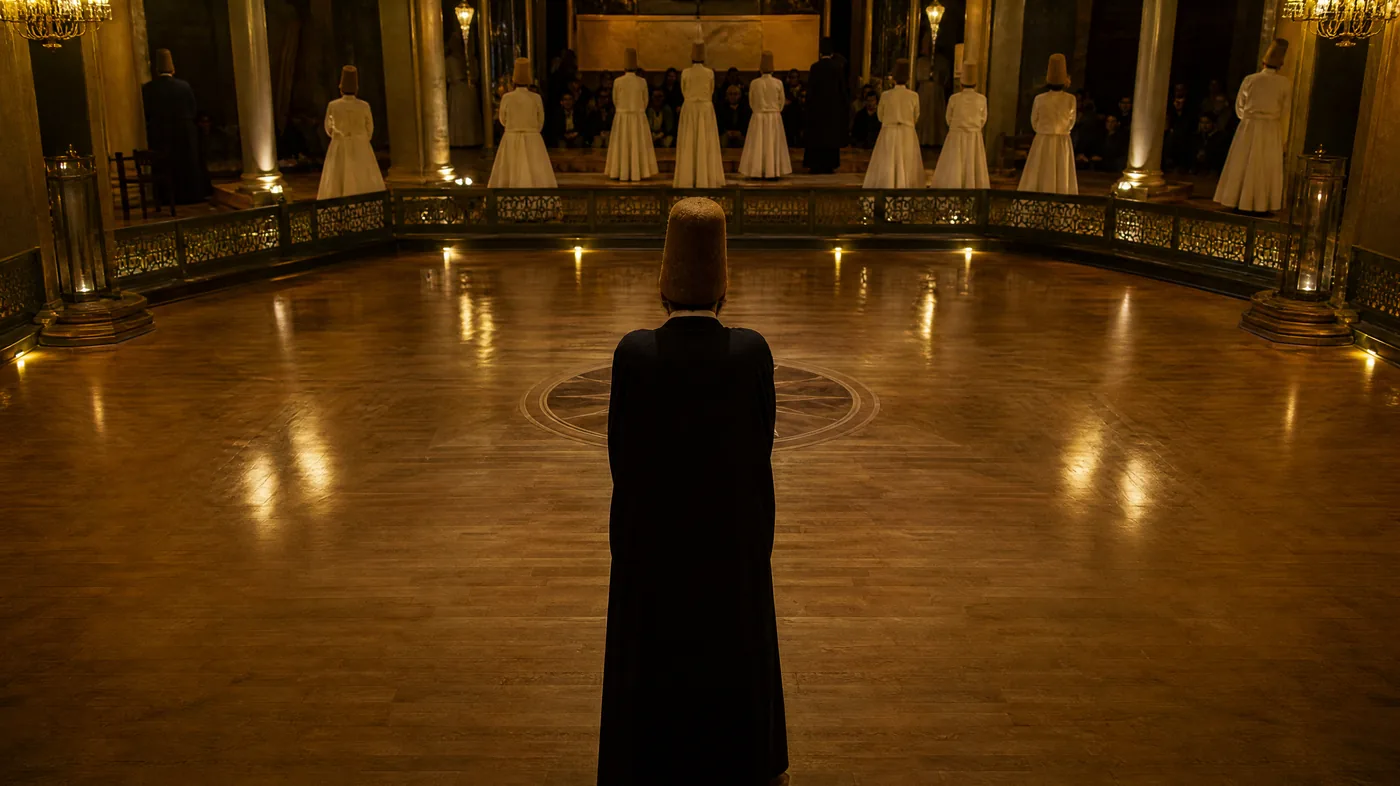
Watch the opening carefully. The dervishes enter in black, walk the floor, then drop the cloaks together, and the white appears all at once. It is one of the most striking moments of the evening.
What are the four parts of the Sema ceremony?
After a hymn to the Prophet, a ney improvisation and a slow walk, the whirling comes in four selams. A Quran recitation closes the ceremony.
- Naat-i Sharif: a solo singer offers a eulogy to the Prophet Muhammad, followed by a taksim, an improvisation on the ney that stands for the divine breath.
- Devr-i Veled: the dervishes walk the hall three times in single file, bowing to one another, then remove their black cloaks.
- The four selams: four distinct musical movements and the heart of the ceremony. Per Celalettin Celebi and Kabir Helminski, quoted by Wikipedia, the first stands for birth to truth through knowledge, the second for rapture before creation, the third for rapture turned into love, the fourth for the semazen accepting his destiny as a servant of God.
- Recitation: the ceremony closes with a reading from the Quran.
Venues describe the order in their own words. The lodge's sheikh explains the four selams before the ritual; HodjaPasha's listing ends its program with a Fatiha for the souls of all prophets, martyrs and believers. Sunil, at the lodge in Oct 2026: "The small introduction and the prayer performance provided a window into Sufi philosophy and traditions."
The resident sheikh explains the robes, the hands and the four selams before the dervishes enter.
Check dates for the ceremony in a real Mevlevi lodgeHow do whirling dervishes not get dizzy?
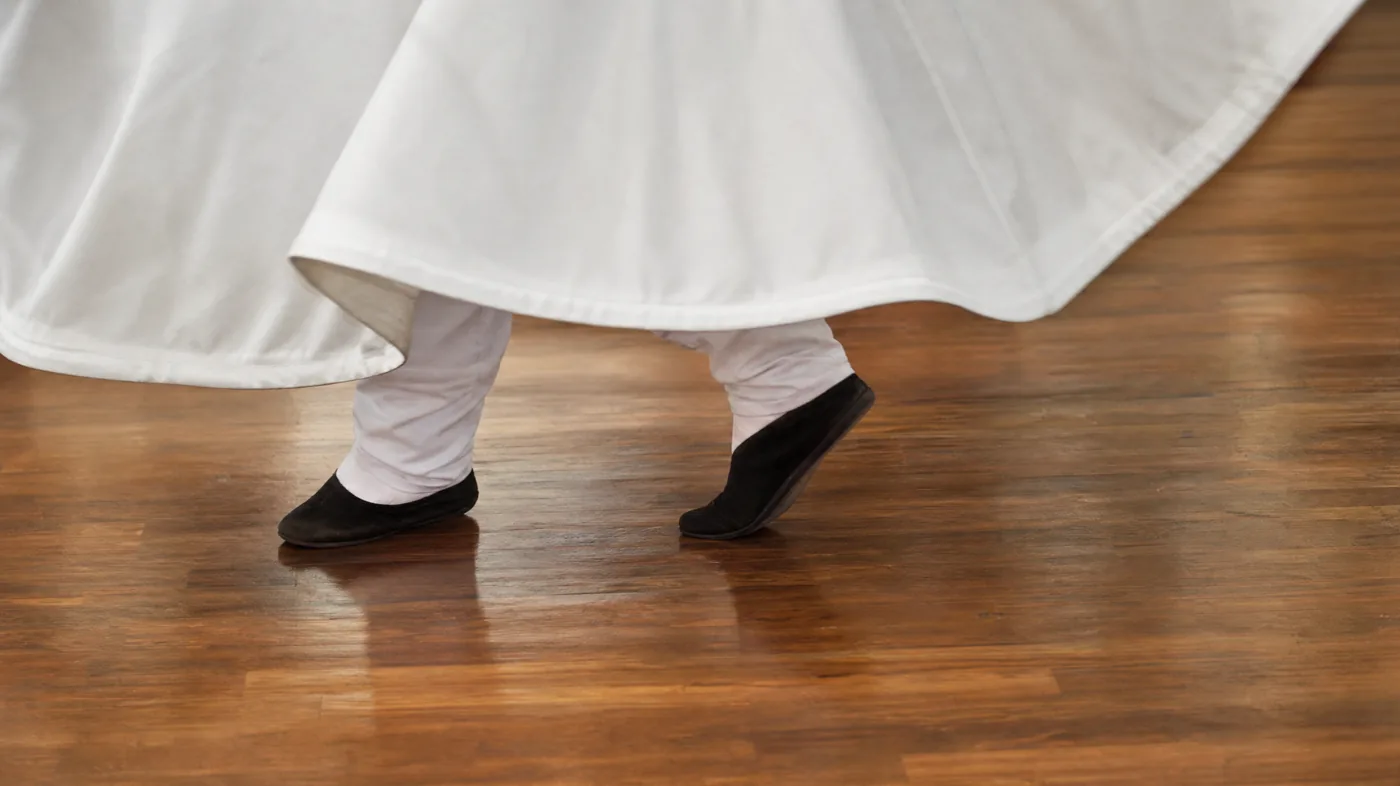
Technique and years of practice. UNESCO describes short twists on the left foot, driven by the right, with the eyes open but unfocused so that images blur; dervishes once trained for 1,001 days in a lodge.
The technique, per UNESCO: after a recommended fast of several hours, the whirlers rotate on the left foot, using the right foot to drive the body round it. The body stays supple, and the eyes stay open but unfocused. Wikipedia adds that the ball of the left foot is the center of the turn and the whole foot keeps contact with the floor. If a dervish becomes too enraptured, another dervish in charge of the order of the ceremony gently touches his frock to slow him.
Science has looked at it too. A 2017 study in Frontiers in Human Neuroscience (Cakmak and colleagues) scanned the brains of 10 Sufi whirling dervishes and 10 people who did not meditate, and found thinner cortex in regions linked to the perception of motion and body position. It is a small study and shows a link, not a cause. A 2013 Imperial College London study in Cerebral Cortex found something similar in ballet dancers: years of spinning training changed how their brains handled the signal from the balance organs, and the researchers said spotting alone did not explain it.
How long do whirling dervishes spin for?
The ceremonies on this site last 40 minutes to an hour, and the whirling comes in four stretches, the selams, rather than one long spin.
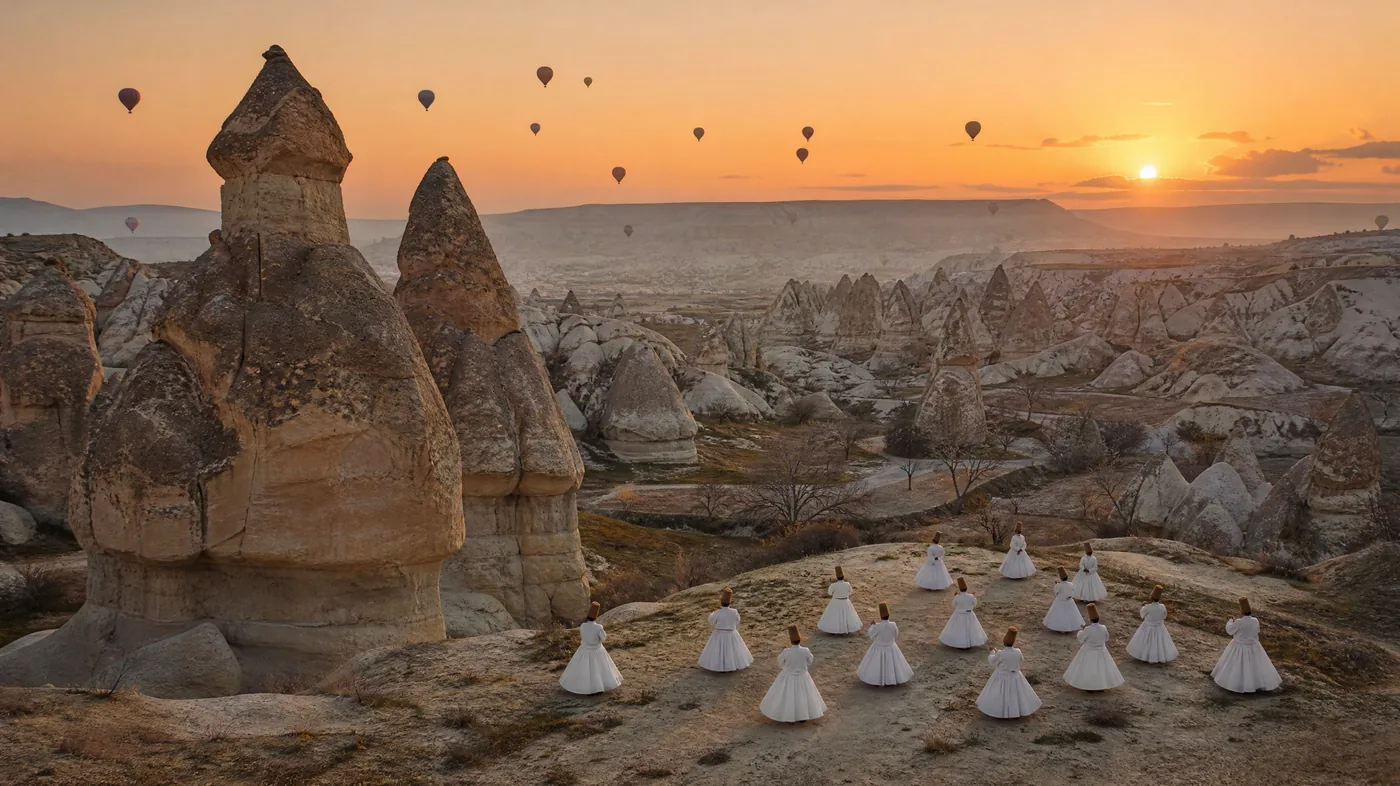
HodjaPasha's Sema runs 60 minutes, and so do the lodge ceremony and Hoca Rüstem Medrese. The Hagia Sophia hall runs 55 minutes and the cistern 45 minutes. In Cappadocia, the ceremony with pickup is a 40-minute Sema and the Goreme cave ceremony a performance of about 50 minutes. Music, the opening walk and the prayers fill the rest of each hour.
Can they go longer? The 2017 Frontiers study opens with the line that whirling dervishes "can spin continuously for an hour without a vertigo perception". UNESCO also notes that many ceremonies for visitors today are shorter and simpler than the traditional form, which is one reason the venue and its program are worth a look before you book.
How do you become a whirling dervish?
Historically, through 1,001 days of training in a Mevlevi lodge. Today the path runs through a Mevlevi teacher or group; there is no public application.
UNESCO describes the old way: dervishes received 1,001 days of reclusive training in the mevlevihane, learning ethics, codes of behavior and beliefs through prayer, religious music, poetry and dance. After that they stayed members of the order but went back to their work and families. All the lodges were closed in 1925; public performances were allowed again in the 1950s, and restrictions eased in the 1990s.
Today, per Wikipedia, the order is overseen by the Çelebi, a descendant of Rumi, who appoints the sheikhs, and practising Mevlevis under a recognised sheikh can be found across the globe. UNESCO adds that some private groups are bringing back the spiritual, intimate character of the ceremony. For visitors, the nearest thing to a first lesson is hearing it explained by people who practise it. Can women whirl too? Practice differs between groups; the Sufi and Rumi guide has what the sources say.
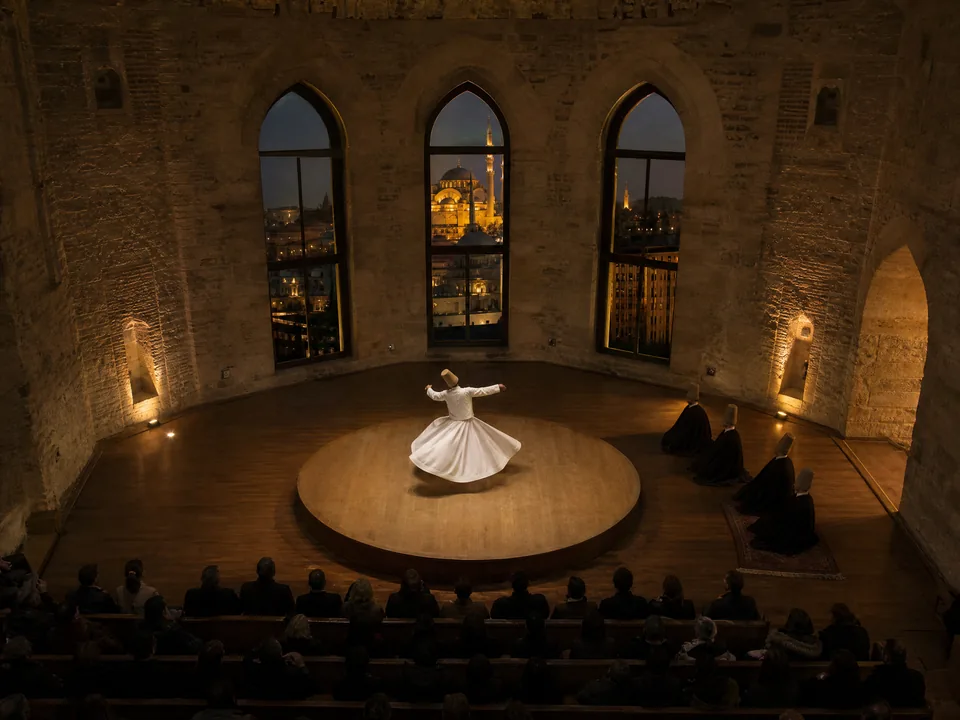
A professional host explains the ritual before and after the ceremony, with tea or sherbet and an audio guide in 8 languages.
Explore the ceremony next to Hagia Sophia Tour detailsWhere can you see the Sema explained before it starts?
At the Kasimpasa lodge, where the sheikh introduces it in Turkish and English, and at the hall next to Hagia Sophia, where a host explains it before and after. HodjaPasha gives you a booklet and an exhibition.
- A spoken introduction: the lodge ceremony (rated 4.7 from 194 reviews) and the Hagia Sophia hall (rated 4.4 from 1,390 reviews). Monica, at the Hagia Sophia hall in Oct 2026: "The Whirling Dervish prayer ceremony was fascinating and educational."
- Read before you sit: HodjaPasha has a program booklet and a dervish exhibition with clothing, instruments, Rumi's poems and Sufi music samples.
- In your ear: Hoca Rüstem Medrese has an audio guide app for your phone.
If the meaning is what draws you, the lodge is our pick: it is a working Mevlevi house, and the introduction covers exactly the questions on this page.
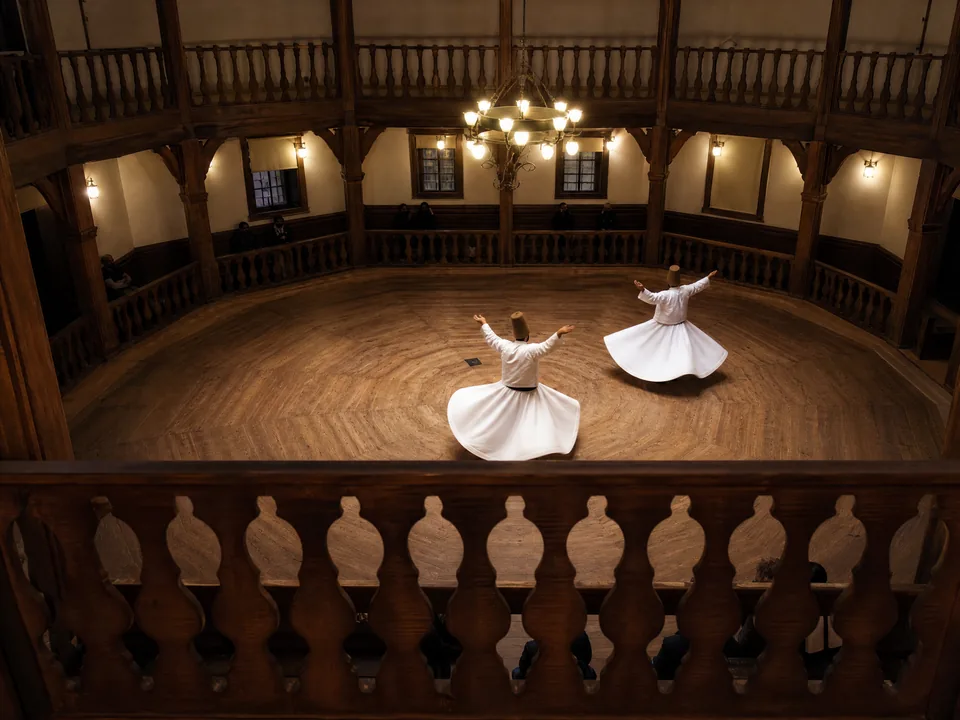
The Sema in a 1620s Mevlevi lodge in Beyoglu, with the resident sheikh's bilingual introduction and two exhibitions.
Explore the ceremony in a real Mevlevi lodge Tour detailsFrequently asked questions
Is the whirling dervish ceremony a dance?
It looks like one, but it is a religious ceremony. HodjaPasha calls it "a spiritual ceremony that contains religious symbols", and GoTürkiye calls it a mystical ceremony with religious elements and detailed rules.
Which way do whirling dervishes spin?
Counter-clockwise, from right to left around the heart, turning on the left foot and pushing with the right, per UNESCO and Wikipedia.
Why is one hand up and one hand down?
The right palm faces the sky to receive God's grace, and the left faces the earth to pass it on, per the Mevlevi symbolism described by Wikipedia.
What music is played at a Sema?
The ayin, in four sections of vocal and instrumental pieces, played by at least one singer, a ney player, a kettledrummer and a cymbal player, per UNESCO.
Ready to book
Choose your ceremony
Free cancellation up to 24 hours before on every option. Prices are from-prices in USD and move with the season.
Whirling Dervishes Ceremony in a Real Mevlevi Lodge
- Whirling dervishes ceremony
- Bilingual introduction
- Exhibition access
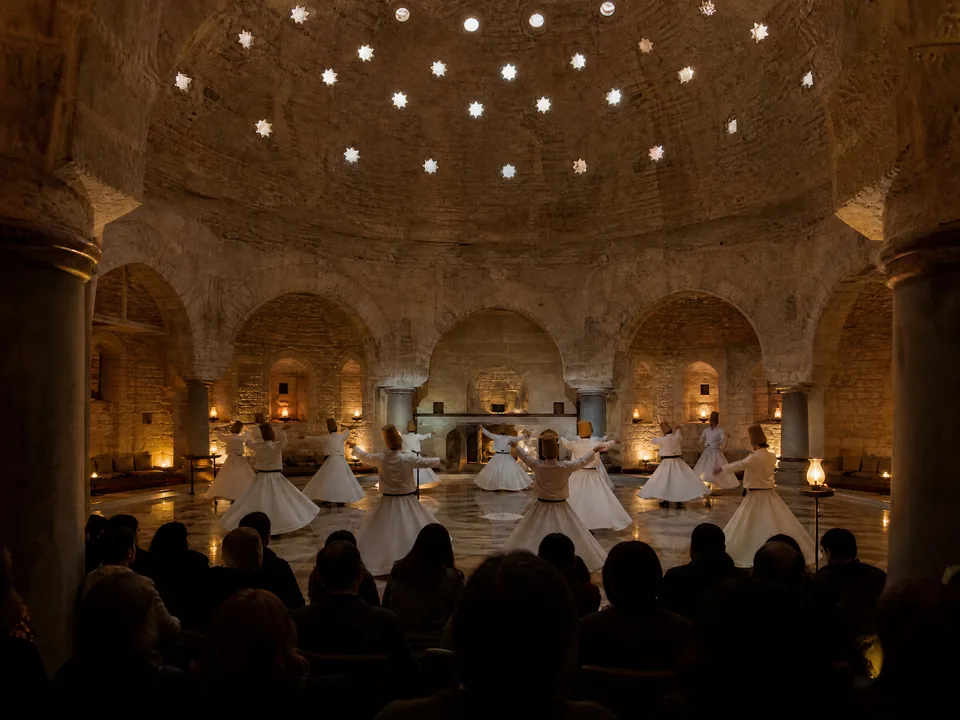
HodjaPasha Whirling Dervishes Ceremony & Exhibition
- Sema ceremony ticket
- Program booklet
- Bottled water
Whirling Dervish Ceremony next to Hagia Sophia
- Ceremony entry with live music
- Tea or sherbet and water
- Smart audio guide in 8 languages